🔊 1. What we know about the Satosphère audio system
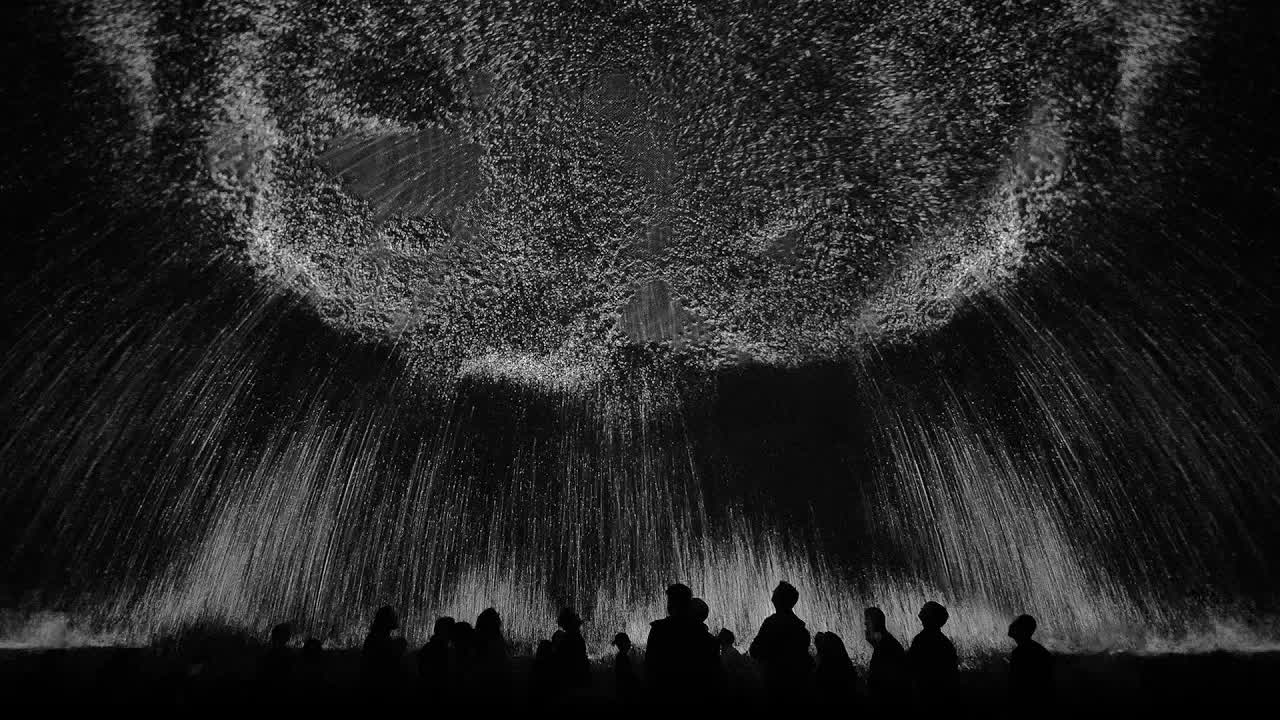
SAT's own pages describe the dome as 18 m in diameter and 11.5 m high, with 8 video projectors and "93.5 haut-parleurs": 93 full-range speakers and 5 low-frequency channels.[1][2] In a June 2024 article SAT adds that the Satosphère is a 210-degree, non-inclined hemispherical dome over a dance floor. The room is modular and takes up to 750 people, and the speakers are spread over 4 height levels. The system was entirely revamped thirteen years after the 2011 opening.[3]
| Dome | 18 m diameter, 11.5 m high, 210°, not tilted[1][3] |
| Speakers (official) | 93 full-range + 5 low-frequency channels ("93.5")[2] |
| Speaker layout | 4 height levels[3] |
| Audience | Up to 750, modular room, flat floor[3] |
| Spatialisation in practice | SpatGRIS (GRIS / Université de Montréal with SAT), often driven from Ableton Live[7] |
| Alternative count in circulation | "157 channels" (unresolved)[4][5] |
93.5 or 157?
A RISD/Brown concert note says a piece was installed at SAT Fest 2024 "using the Satosphere's 157 channel loudspeaker array".[4] Électro-Acrylique's Satosphère page also lists 157 speakers.[5] SAT's main venue page still says 93.5. The gap could come from a different counting method, the post-revamp setup or an extended configuration. We haven't been able to resolve it. For anyone producing for the dome, the current speaker plan from SAT (positions and channel map) is the most important input there is.
Why "not tilted" matters for sound
Many planetariums are tilted domes with a front. The Satosphère is a level hemisphere over a flat floor where people stand, walk or lie down.[3] There's no front and no sweet spot. Every listener hears the dome from a different position, and that shapes which spatialisation methods work (see section 2).
The tools around the dome
- SpatGRIS is developed at the Groupe de Recherche en Immersion Spatiale (GRIS) and SAT.[7] It works with any speaker layout, including domes, and can mix down to binaural or stereo.[7] Its DOME mode uses Vector Base Amplitude Panning (VBAP), and its CUBE mode uses Matrix Base Amplitude Panning for other layouts. It handles up to 256 inputs and outputs.[8]
- SATIE is SAT's own SuperCollider-based spatialisation engine (VBAP and Ambisonics) on SAT's GitLab.[9]
- xp4l (Eric Raynaud) brings IRCAM Spat~ into Ableton Live with up to 62 outputs, VBAP/HOA in 2D and 3D, and binaural monitoring. It grew out of a SAT residency.[10]
- In 2026 SAT also opened a sound studio with 97 Meyer Sound MM-4XP speakers, a modular "allocentric" setup that works wherever you stand. SAT's R&D group built Audiodice: five dodecahedral speakers with 12 drivers each.[6] A room like that is a natural place to prepare dome work before getting dome time.
🧪 2. The science: why 93 channels don't simply shrink
A speaker mix is a render, not a master
A 93-channel file is already rendered for one geometry. Fold it onto 16 speakers and each speaker carries several feeds that were meant for different directions. You get comb filtering, phantom images collapsing onto the nearest box, and a muddy upper hemisphere. The portable unit has to be the scene, meaning sources plus positions, and not the speaker feeds.
Three ways to render
Amplitude panning (VBAP / MBAP / DBAP)
Places each source between the 2–3 nearest speakers. Sharp, and robust for listeners far off-centre, which is ideal for a flat-floor room with no sweet spot. This is what SpatGRIS DOME mode does.[8] It works on any layout as long as you know the speaker positions.
Higher-Order Ambisonics (HOA)
Encodes the whole sound field as spherical harmonics: order N uses (N+1)² channels (3rd = 16, 5th = 36, 7th = 64). Irregular layouts and hemispheres are decoded with AllRAD. IEM's AllRADecoder builds decoders up to 7th order for any layout and fixes the missing lower half with an imaginary speaker below the listener, set to zero gain.[11] HOA is great for beds and ambiences, but at low orders the sweet spot is small.
Wave-field synthesis / beamforming
Rebuilds wavefronts physically. That needs dense, purpose-built arrays such as the Sphere's Holoplot system or RISD's custom WFS array.[4] It isn't something a touring dome show can rely on.
Order, speaker count and audience area
As a rule of thumb, a decoder of order N wants at least (N+1)² well-distributed speakers. So 93 speakers can in principle carry around 7th order, a 16-speaker dome around 2nd–3rd order, and 5.1 roughly first order in the horizontal plane only. The area that sounds right grows with order and shrinks with frequency. Listeners off-centre in a big dome also hear the nearest speaker first (the precedence effect), so low-order point sources get pulled towards the wall next to them. That's why big-dome practice uses amplitude-panned objects for anything that must localise and HOA for diffuse beds. Zotter & Frank's open-access Ambisonics is the standard reference for the theory.[12]
Dome acoustics and bass
Concave domes focus reflections towards the centre. The results are flutter echoes, "whisper" spots and a boomy middle, and percussive, transient-heavy music exposes them hardest. Every venue needs its own delay and level alignment per speaker, plus decoder-output EQ. Below about 80–120 Hz bass is barely directional, so it should travel as its own LFE stem and get bass-managed to whatever subs the room has: five at SAT, four d&b E15X at CULTVR Cardiff, maybe one in a planetarium.
🧭 3. Strategy: one scene, many renders
The master: a scene package
- Objects: roughly 8–32 mono stems with azimuth/elevation/distance automation, for everything that has to localise (hits, voices, moving elements).
- HOA bed: 5th order (36 ch, ACN/SN3D) if possible, 3rd order (16 ch) as the minimum. Ambiences and reverbs go here. You can lower the order by simply dropping the higher channels.
- LFE stem(s), kept out of the scene.
- Metadata: the open EBU Audio Definition Model (ADM in BW64) can carry objects, HOA and channel beds together, and the EBU ADM Renderer (EAR) is an open-source baseline renderer.[13] For live use, the same trajectories can run as OSC into SpatGRIS.
- Reference renders: binaural, 5.1/7.1 and stereo.
Live: render on site
For a live A/V show the scene is rendered in real time. Ableton or SuperCollider feeds the objects and the HOA bus into a renderer on the show machine (SpatGRIS, IEM Plug-in Suite or SPARTA), which drives the venue's speakers over Dante or MADI. Positions travel as OSC, so the visual engine and the audio renderer share one coordinate bus, and sound and image stay together in any dome. The only thing that changes per venue is a layout file. It holds the speaker positions and channel map, and from it you generate the VBAP triangulation, the AllRAD decoder and the delay/gain/EQ preset.
🏛️ 4. Venue tiers
Tier S: Satosphère (93.5, possibly 157 channels)
Objects through SpatGRIS DOME (VBAP). The HOA bed is decoded at 5th order onto the same outputs. The LFE stem is bass-managed to the 5 subs. Prepare in the 97-speaker studio if SAT gives access.
Tier A: 3D domes with 16–40 speakers
Example: CULTVR Cardiff, 16 × d&b 5S plus 4 subs, either a 1:1 patch over Dante or d&b Soundscape objects. Objects go through VBAP on the venue layout, and the bed is decoded at 3rd order. Phantom sources are spaced wider here, so thin out dense object passages and let the bed carry the atmospheres.
Tier B: planetarium 5.1 / 7.1
Objects are panned onto the horizontal ring, with elevation suggested through level and spectral cues. The bed becomes a first-order horizontal decode or a premixed channel bed. Height is lost, so movement and dynamics have to carry the show.
Tier C: stereo and binaural
A binaural render for headphones, juries and press, and a stereo fold-down for streaming. Head-tracked binaural (IEM BinauralDecoder, SPARTA) makes remote rehearsal possible.
Rules that keep it portable
- Lowest common denominator first: every key musical event must still read on Tier B. Height and fine motion are the bonus layer.
- Transients are objects: frame-exact, sync-critical hits never live in the Ambisonics bed.
- Check fold-downs: heavily decorrelated reverbs collapse badly in mono and stereo.
- Agree loudness per venue, from film-style delivery levels to club level.
🗺️ 5. A step-by-step plan
❓ 6. Open questions
- 93.5 or 157 channels, and what are the exact positions and channel map?
- Do visiting artists bring their own renderer (1:1 patch) or use a house SpatGRIS rig?
- Is there an official SAT HOA decoder, and if so at what order?
- Is the flat floor with a roaming audience the default for live shows?
We'll update this article as answers come in.
📚 Sources
- SAT – Satosphère (FR)
- SAT – Satosphere (EN)
- SAT – Fulldome immersive creation: A panorama (June 2024)
- Brown Arts Institute – Residual Noise: SRST Spatial Audio Concert
- Électro-Acrylique – EA+Satosphère
- CTVM – 30 ans pour la SAT (April 2026)
- SpatGRIS – GRIS-UdeM on GitHub
- GRIS – SpatGRIS & ControlGRIS
- SATIE – SAT GitLab
- IRCAM Forum – xp4l
- IEM – AllRADecoder guide
- Zotter & Frank – Ambisonics (Springer 2019, open access)
- EBU ADM Guidelines – Rendering / EAR
Published October 5, 2026 · Venue facts from SAT's own pages where available. Statements without a citation reflect established spatial-audio practice, not venue-confirmed specs.