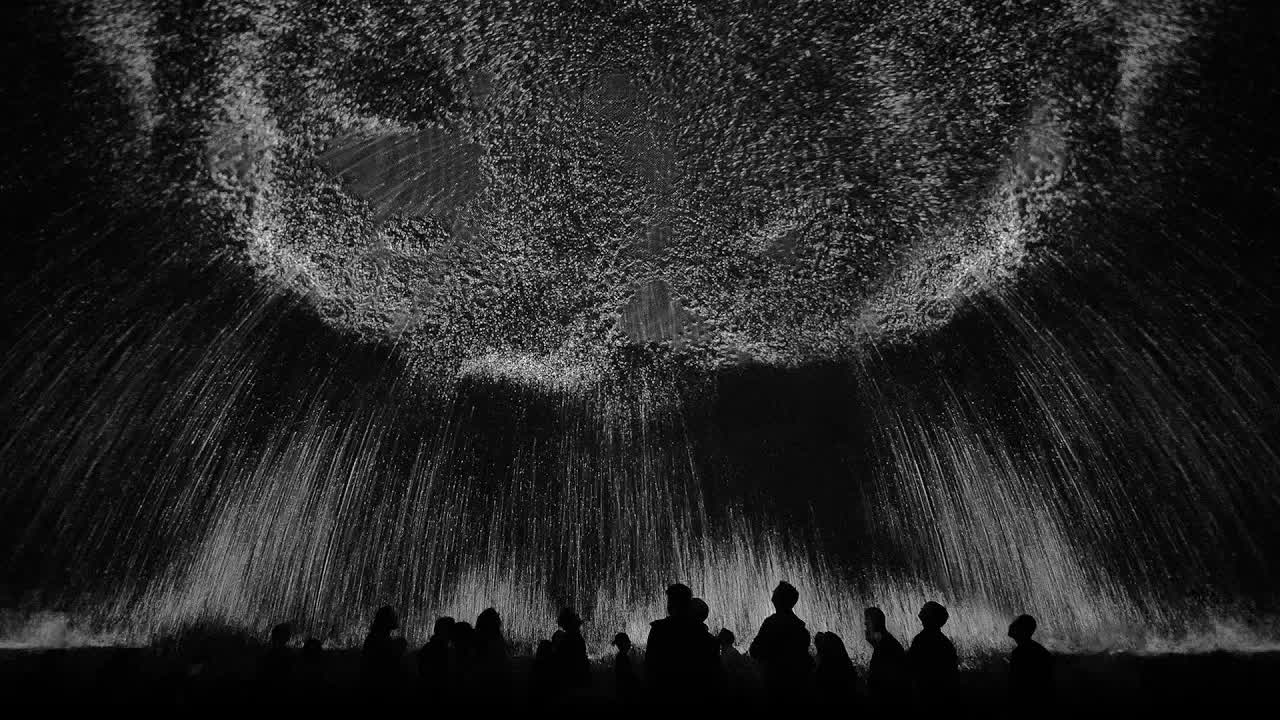
🏛️ The Satosphère
The Société des arts technologiques (SAT) was founded in 1996 in Montréal's Quartier des Spectacles as an organization dedicated to the development of digital culture. But it was in October 2011 that the SAT made history: it inaugurated the Satosphère — the world's first permanent immersive modular theatre dedicated to artistic creation.
This isn't a planetarium. It was never meant to show star fields or science documentaries. From day one, the Satosphère was built as a creation tool — a space where artists could explore what happens when you wrap images and sound around an audience and dissolve the boundary between viewer and work.
The dome's modular screen configuration supports 180° or 210° vertical by 360° horizontal coverage. It was renovated in 2024, upgrading the sound system from the original 93 speakers and 5 subwoofer channels to the current 157-speaker array — making it one of the most dense speaker installations in any dome on Earth.
The SAT also operates R&D laboratories, hosts artist residencies, and develops open-source tools for immersive creation. It's not just a venue — it's an ecosystem. And the Satosphère is its beating heart.
The Satosphère — SAT's official overview of the dome and its capabilities. Source: Society for Arts and Technology
🚀 The First Wave
From the moment it opened, the Satosphère attracted artists who had been waiting for exactly this kind of space. The first years established the SAT as a laboratory — a place where the grammar of immersive art was being written in real time.
LOCO-DYNA-MORPHICS — Stefan Berke & Jan Zehn (2013)
One of the most important works ever created for the Satosphère. LOCO-DYNA-MORPHICS (LDM) by Stefan Berke and Jan Zehn is an audiovisual essay on the physics of natural numbers, made under their TEN ART COMMUNICATIONS / CymaSonics label in association with the SAT and premiered in the Satosphère in May 2013. It's a deeply rigorous yet visually overwhelming piece: Chladni patterns, cymatics, and mathematical structures rendered as fulldome projections with spatial audio.
The roots of this work go back even further — Berke and Zehn's first fulldome piece, CymaSonics — Matrix Optimizer 1.0.1 (2010), premiered at the Fulldome Festival Jena, exploring cymatics and audio-animated visuals in the dome format. After later international presentations of Matrix Optimizer 2.0, the duo was invited in late 2012 to create LDM for the SAT. The full work is available online, and it remains a benchmark for what fulldome art can achieve when given the time and support to develop properly.
CymaSonics — Matrix Optimizer 1.0.1 (2010) — Jan Zehn & Stefan Berke's very first fulldome piece, premiered at FullDome Festival Jena. The seed that grew into LOCO-DYNA-MORPHICS. Source: CymaSonics
By 2012, they had evolved the concept into Matrix Optimizer 2.0 — their third contribution to the Fulldome Festival Jena, and a leap forward: this version introduced 3D audio-animated visuals performed on 21 hemispherically placed virtual audio channels, delivered by the Fraunhofer IDMT's new SpatialSound Wave system, freshly installed in the Zeiss Dome Jena. Sound and image as one unified spatial instrument — the approach they would bring to the SAT the following year.
CymaSonics — Matrix Optimizer 2.0 (2012) — 3D audio-animated visuals on the Fraunhofer SpatialSound Wave system at the Zeiss Dome Jena. 25 minutes of cymasonical fulldome. Source: CymaSonics
LOCO-DYNA-MORPHICS — the full 50-minute audiovisual essay on the physics of natural numbers by Stefan Berke & Jan Zehn (TEN ART COMMUNICATIONS / CymaSonics), created in association with the SAT, Montréal, 2013. Source: CymaSonics
Dromos — Maotik & Fraction (2013)
The work that put the Satosphère on the international map. Dromos was a fully generative immersive performance created by digital artist Maotik (Mathieu Le Sourd) and electronic musician Fraction (Eric Raynaud). Premiered at MUTEK 2013 in the Satosphère, it transformed the dome into a reactive data environment — real-time visuals driven by algorithms, wrapped around the audience, synchronized with Fraction's spatial electronic score.
Dromos wasn't pre-rendered. Every performance was unique — generated live from code. It was one of the first works to fully exploit what the Satosphère was designed for: not playback, but creation in real time. The piece went on to tour international venues and became a touchstone for the fulldome art community.
Dromos — an immersive performance by Fraction & Maotik, premiered at MUTEK 2013 in the Satosphère. Source: Eric Raynaud aka Fraction
Maotik (Mathieu Le Sourd)
Montréal-based digital artist working with data visualization, generative systems, and immersive environments. His work transforms raw data — weather, network traffic, biological signals — into living visual landscapes. Beyond Dromos, his portfolio spans installations (Bloom, Flow, Shelter, Hyperform) and performances worldwide. He remains one of the most important figures in the SAT's artistic history.
Fraction (Eric Raynaud)
French electronic music artist and sound designer who collaborated with Maotik on Dromos. His solo work Entropia (2015) explored immersive audiovisual performance with spatial sound design, touring dome venues and festivals across Europe and North America. His practice sits at the intersection of electronic music composition and immersive spatial audio.
Entropia — Fraction's solo immersive audiovisual performance, extending the language established in Dromos. Source: Eric Raynaud aka Fraction
Intérieur — Kondition Pluriel (2012)
One of the earliest dance works created for the Satosphère. Kondition Pluriel — the Montréal-based performance duo of Marie-Claude Poulin and Martin Kusch — created Intérieur, an immersive dance piece where performers moved within the dome's projected environment. The dome wasn't a backdrop; it was a partner. Sensors tracked the dancers, and the visual environment responded to their movement in real time.
This was groundbreaking for the dome world: bodies in the space, interacting with projections that wrapped around both performers and audience. It proved the Satosphère could be a stage for physical performance, not just a screen for digital content.
Intérieur — Kondition Pluriel's immersive dance performance, co-produced by Agora de la danse and SAT. Source: Agora de la danse
Early VJing — Allison Moore (2009)
Even before the Satosphère's official inauguration, artists were experimenting with the dome. In 2009, VJ Allison Moore performed live visual mixing inside the SAT's dome — making this some of the earliest footage of artistic performance in the space. Raw, early, and full of potential.
Allison Moore — live VJ mixing in the Satosphere, Montréal, 2009. Some of the earliest artistic footage from the dome. Source: allisonmoo
The Demo Reel (2013–2014)
In its first years, the SAT produced a demo reel showcasing the Satosphère's capabilities — a compilation of artistic works, technical demonstrations, and immersive experiments. It captures the raw excitement of a community discovering what this new instrument could do.
Démo Satosphère 2013–2014 — compilation of early artistic works and technical capabilities. Source: Société des arts technologiques [SAT]
🎛️ MUTEK in the Dome
The partnership between the Satosphère and MUTEK — Montréal's festival of electronic music and digital creativity, founded in 2000 — has been one of the most productive relationships in immersive art. Since the dome opened, MUTEK has programmed performances in the Satosphère as part of its annual festival, bringing international electronic artists into the 360° environment.
The list of artists who have performed in the Satosphère through MUTEK reads like a who's who of experimental electronic music: Robert Hood (minimal techno pioneer), Apparat, DJ Food (Ninja Tune), and dozens more — all performing inside 18 metres of projected light and spatial sound.
DJ Food — "The Search Engine" live at SAT, Montréal, July 2012. A Ninja Tune artist performing inside the dome. Source: Ninja Tune
Boiler Room × MUTEK in the Dome
Boiler Room — the globally influential music broadcasting platform — brought its "Frontiers" series to the Satosphère during MUTEK. Minimal techno pioneer Robert Hood (Underground Resistance, Detroit) performed inside the dome, and Iron Galaxy delivered a set surrounded by 360° projections. These Boiler Room sessions introduced the Satosphère to a massive international audience who might never have heard of fulldome art.
Iron Galaxy performing at Boiler Room "Frontiers" during MUTEK 2016 @ Satosphere. Source: neonyme
Clark @ MUTEK 2012
Warp Records artist Clark performed in the Satosphère during MUTEK 2012 — bringing his glitchy, high-energy electronic music into the dome. The 360° visual environment transformed his characteristically intense live show into a fully immersive audio-visual assault.
Clark @ MUTEK 2012 in the SATosphère. Source: PKMTL
Tiga @ Satosphère (2013)
Montréal's own Tiga — the DJ, producer, and Turbo Recordings founder — played the Satosphère in spring 2013. A hometown hero inside the city's most unique venue.
Tiga @ SATosphère, Montréal, Spring 2013. Source: Vince De là et d'ailleurs
biliminal — MUTEK 2021
During the pandemic-era MUTEK 2021, biliminal performed SANSPERTE_LOSSLESS in the Satosphère — an extended audiovisual immersive set that exemplifies how the dome serves as an instrument for experimental electronic artists.
SANSPERTE_LOSSLESS — biliminal at MUTEK Montréal 2021, performed in the Satosphère. Source: Colariboo
MUTEK's partnership with the SAT also includes the Itérations Immersives program — a co-production initiative funded by the Conseil des arts et des lettres du Québec that supports artists in creating new immersive works specifically for the Satosphère. For SAT Fest 2026, this program supported Les Empires by Line Katcho & Guillaume Coutu Dumont.
🌍 The International Stage
NONOTAK — VERSUS at SAT (2019)
NONOTAK — the Paris/Tokyo-based duo of Noemi Schipfer and Takami Nakamoto — brought their VERSUS performance to the Satosphère, transforming the dome into a pulsing geometric world of light and sound. NONOTAK's signature style — precision-engineered audiovisual architectures where light behaves as a sculptural material — found its ideal canvas in the 360° dome environment.
Where most of their installations use flat surfaces and screens, the dome freed their work to surround the audience completely. The result was one of the most visually striking dome performances ever staged.
NONOTAK — VERSUS at SAT Montréal. Geometric audiovisual architecture in 360°. Source: NONOTAK
NONOTAK Studio
Noemi Schipfer and Takami Nakamoto create immersive light and sound installations that explore the boundaries of perception. Their work — DAYDREAM, SHIRO, HOSHI, VERSUS, SORA — has been exhibited globally, from TodaysArt to the Jerusalem Light Festival. The VERSUS dome performance at SAT remains one of their most complete realizations of surrounding an audience with synchronized light and sound.
Joanie Lemercier — CONVEX
Belgian light artist Joanie Lemercier created CONVEX — an audiovisual performance designed specifically for dome projection. Lemercier, known for his large-scale architectural projection mapping, used the dome to explore how light and geometry interact on a curved surface. In a flat-screen world, his work creates illusions of depth. In the dome, the depth was real — surrounding the audience in shifting topographies of light.
CONVEX — Joanie Lemercier's audiovisual dome performance exploring light on curved surfaces. Source: Joanie Lemercier
Joanie Lemercier
Brussels-based artist working with light as a primary medium. His projection mapping work on architectural surfaces — cathedrals, monuments, natural landscapes — has been seen worldwide. CONVEX adapted his practice to the dome format. Also prominent in climate activism through projected art. Co-founder of the AntiVJ visual label.
MONOCOLOR — Entangled Structures & Latent Space
MONOCOLOR is the Vienna-based audiovisual artist Marian Essl, who was artist in residence at the SAT in 2019. His fulldome works include Latent Space, Transient Topologies and Entangled Structures. His practice sits at the intersection of generative visuals, spatial sound, and live performance — creating evolving audiovisual landscapes that morph in real time across the dome surface.
His work Latent Space, performed at the SAT among other venues and winner of a New Face Award at the 2020 Japan Media Arts Festival, explored the aesthetics of machine learning and neural networks rendered as fulldome audiovisual compositions — a genuine intersection of AI art and dome projection.
Entangled Structures — MONOCOLOR's fulldome audiovisual performance at SAT Montréal. Source: MONOCOLOR
Latent Space — MONOCOLOR's fulldome AV performance exploring neural network aesthetics, performed at SAT Montréal. Source: MONOCOLOR
MONOCOLOR (Marian Essl)
Austrian audiovisual artist creating fully generative fulldome performances and installations. He was artist in residence at the SAT in 2019, and his work has been shown at SAT Montréal, Ars Electronica, MUTEK.JP, Fulldome Festival Jena, Fulldome UK and Sphere Las Vegas, among others. Entangled Structures and Latent Space represent some of the most sophisticated audiovisual dome work being made today — real-time generative systems that treat the dome as a unified audiovisual instrument.
Alba G. Corral & Alex Augier — end(O)
Barcelona-based visual artist and creative coder Alba G. Corral collaborated with French electronic musician Alex Augier to create end(O) — an immersive audiovisual performance co-produced by the SAT and Elektra festival (Montréal), with additional co-production from Stereolux (Nantes) and support from La muse en circuit (Alfortville). The piece was created specifically for the Satosphère with 3D Ambisonic sound (up to 31 channels) and fulldome projection.
end(O) fused Corral's organic, generative visual language with Augier's spatial electronic compositions into what they describe as "poetic hypermedia" — where sound, image, space, and time become a single synesthetic entity under the control of both performers. No dimension dominates; each enriches the other. The work is listed on FDDB and has been adapted for different immersive environments, but the Satosphère was its birthplace.
end(O) — official teaser. Immersive audiovisual performance co-produced by SAT, Elektra, Stereolux, and La Muse en Circuit (2018). Source: Alba G. Corral
Alba G. Corral
Visual artist and creative coder who performs live audiovisual sets with orchestras, electronic musicians, and in immersive spaces. Her work spans projection mapping (Mapping Casa Navàs, Lux Mundi), immersive dome performances (end(O)), and collaborations with symphonic orchestras. She codes her own visual instruments, creating generative organic forms that respond to live music — bridging classical performance, creative coding, and dome art.
Tamiko Thiel — Gardens of the Anthropocene (2019)
AR and immersive art pioneer Tamiko Thiel — one of the most respected names in digital art, active since the 1980s — brought Gardens of the Anthropocene to the SAT. The work explored the collision between natural and artificial ecosystems through immersive projected environments inside the dome. Thiel's presence at the SAT highlighted the venue's ability to attract artists from the broader digital art world, not just the fulldome community.
Tamiko Thiel — Gardens of the Anthropocene at the SAT, Montréal. Source: tamiko thiel
Tamiko Thiel
Virtual and augmented reality artist active since the 1980s. Co-designer of the Connection Machine supercomputer (1986). Her immersive art explores the boundary between virtual and physical worlds, and has been exhibited at the Venice Biennale, the Museum of Modern Art, and major institutions worldwide. Gardens of the Anthropocene extended her practice into the dome format.
The Soft Moon at SAT (2022)
The Satosphère isn't just for digital artists. In December 2022, darkwave band The Soft Moon (Luis Vasquez) performed a full concert inside the dome — a wall of reverb-drenched guitars and synths, with reactive 360° visuals wrapping around the audience. It was a powerful demonstration that the dome format works for raw, emotional live music, not just abstract digital art.
The Soft Moon — full concert at Société des Arts Technologiques, Montréal, December 2022. 21 minutes of darkwave in the dome. Source: Robot CarnivalXYZ
🎉 Dômesicle — When the Dome Becomes a Club
If the artist residencies and SAT Fest represent the Satosphère's serious, curatorial side, then Dômesicle is where the dome lets loose. Launched as a recurring party series, Dômesicle transforms the Satosphère into a 360° club — DJs, electronic musicians, and VJs performing inside the dome with full spatial audio and immersive visuals.
The format is simple but transformative: take a dance floor, wrap it in 18 metres of projected light and 157 speakers, add a DJ, and let the audience experience electronic music the way it was always meant to be heard — from everywhere at once.
Dômesicle has hosted a wide range of artists — from deep house to drum & bass to experimental electronic. VJ collectives like OCTOV and SCVISIONS have become regulars, creating reactive 360° visuals that transform the dome into a living, breathing environment synchronized to the music.
Dômesicle party at the Satosphère — immersive electronic music in 360°. Source: SCVISIONS
Dômesicle highlights — an immersive dome experience at SAT Montréal. Source: 8day Montreal
Omar Hamdi [OCTOV] performing at Dômesicle, SAT Montréal, January 2019. Source: OCTOV
Beat Market @ SATosphère
Beat Market — the Montréal-born dance music event series — held events inside the Satosphère, proving the dome's versatility as a party venue. The combination of a high-energy DJ and 360° reactive projections creates something that no conventional club can match.
Beat Market @ SATosphère — Montréal. Source: PKMTL
REVIVE — MUTEK 2018
MUTEK's 2018 edition featured an immersive audio-visual experience in the Satosphère. These recurring MUTEK × SAT collaborations have made the dome a regular feature of one of the world's most important electronic music and digital art festivals.
REVIVE — MUTEK Montreal 2018 in the Satosphère. Source: Magic Muffins
Nuit Blanche in the Dome
Every year during Montréal's Nuit Blanche — the all-night art event during the Montréal en Lumière festival — the SAT opens the Satosphère for special programming. These have included everything from DJ sets to immersive visual experiments, drawing thousands of visitors into the dome in a single night.
An immersive DJ performance in the Satosphère during Nuit Blanche. Source: DJ Guapo
The Satosphère during Nuit Blanche at Montréal en Lumière. Source: SynapticTV
🎬 SAT Fest — The World's Immersive Film Festival
Since its first edition in 2012, SAT Fest has become the world's premier event for immersive fulldome cinema. It's not just screenings — it's a full week of premieres, professional activities, artist talks, networking, awards, and a closing Dômesicle party. The festival has fueled the imagination of thousands of spectators and showcased the work of over 100 visual and sound artists, local and international.
SAT Fest 2024 Award Winners
The 2024 edition — the first in the renovated dome — brought together an international selection that showed the range of what fulldome cinema can be:
- Inner Island — Sergey Prokofyev (Germany) — An architectural space inspired by the musical "Souvenir de Puerto Rico." Special mention from the jury.
- Ignite! — Lynn Tomlinson (USA) — A playful celebration of the connection between sound and image. Originality Award.
- Dancing with Dead Animals — Maarten Isaak de Heer / Tote Tiere (Germany) — A virtual paradise composed of organic materials. Innovation Award & Excellence Award.
- Protist Rhapsody — Uncharted Limbo (UK) — An exploration of a single-celled fungus. Soundtrack Award.
- FEED — IMUU (USA) — An immersive panopticon where the audience plays the role of a computer mouse. Narrative Work Award.
- Dream — Ari Dykier (Poland) — A dreamlike journey through an imaginary and subconscious world. Audience Award.
SAT Fest 2026 — March 24–28
The upcoming edition — happening next week — features its most ambitious program yet:
- 35+ films in competition from 15+ countries (Taiwan, Colombia, France, Germany, Mexico, UK, USA, Poland, Mauritius, Québec, and more)
- Special projections: Wayfarer Luren by Weidi Zhang (supported by SAT residency), Terra Flecta by Mesocosm, and Les Empires by Line Katcho & Guillaume Coutu Dumont (MUTEK co-production)
- SAT Fest Pro: Three days of industry panels — open-source immersive tools, dome interactivity with TouchDesigner, co-creation perspectives, and a network development day with international speakers from Taiwan (C-Lab), Brazil (AVX Lab), and Canada (IM4Lab)
- Petit SAT Fest: A new family program with animated short films and interactive drawing workshops
- Closing Dômesicle: Ostr-size (live), Lather Rinse Repeat b2b OJPB, with 360° visuals by SULFATION & JONAHVISION
✨ Beyond the Program
Pink Floyd: The Dark Side of the Moon (2023)
In September 2023, the Satosphère hosted a full immersive screening of The Dark Side of the Moon — a specially produced fulldome visual experience synchronized to Pink Floyd's iconic 1973 album. The show ran for multiple evenings and drew audiences that went far beyond the usual dome art crowd — proof that the Satosphère can operate as a mainstream attraction when the content connects with a wider audience.
Pink Floyd Immersive Experience at the SAT, September 12, 2023. Source: Lightning Brother
Igloofest at SAT (2021)
Igloofest — Montréal's legendary outdoor winter electronic music festival — partnered with the SAT for special dome editions during the pandemic era. DJs performed inside the Satosphère with full immersive visuals, bringing the Igloofest energy indoors and under the dome.
Yehno — full set at Igloofest 2.021 at the Société des Arts Technologiques. Source: Igloofest
Nimbes & Quantum — Kyle Crock
Independent immersive works that found their way into the Satosphère through the SAT's residency and open programming. Nimbes — a fulldome piece exploring clouds and atmospheric phenomena — and Quantum demonstrate the range of artists who have used the dome as a canvas for short-form immersive work.
Nimbes at the Satosphère, Montréal. Source: kylecrock
Construct — Nuit Blanche 2013
A collaborative real-time audiovisual performance that took over the Satosphère during Nuit Blanche 2013. Multiple artists working together — live coding, VJing, and spatial audio — creating an evolving immersive environment throughout the night.
Construct — a collaborative real-time audiovisual performance at the Satosphère during Nuit Blanche Montréal 2013. Source: Construct
👁️ What It Feels Like
Videos can't fully convey what it's like to be inside the Satosphère. The dome is overhead, behind you, in your peripheral vision. The 157 speakers mean sound comes from exact positions in space, not from "left" and "right" channels. But these clips give you a sense of scale and immersion:
Inside the dome — an immersive demo filmed from audience perspective. Source: David Gallardo
Écrin de la SAT — a documentary extract on immersion at the heart of the SAT. Source: Savoir média
Discover the SAT — official introduction to the Société des arts technologiques. Source: Society for Arts and Technology [SAT]
🎨 The Artist Residency Program
One of the SAT's most important contributions is its creation residency program — offering artists time and access to the Satosphère to develop new immersive works. Unlike most dome venues, which primarily screen finished content, the SAT provides the dome as a creation tool: artists can work inside the space, test ideas at full scale, and develop work that wouldn't be possible to create anywhere else.
For SAT Fest 2026, the residency program supported new works by Weidi Zhang (Wayfarer Luren) and Mesocosm (Terra Flecta) — both receiving their premiere at the festival.
The SAT also operates R&D laboratories — an interactive studio, a sound studio, and the Immersion Living Lab — where researchers and artists develop new tools for immersive creation. The SAT's in-house tools include open-source software for spatial audio (SpatGris) and immersive visual content creation, presented at SAT Fest Pro each year.
🔮 What's Showing Now
The SAT continues to produce new immersive works. In early 2026, the dome is showing La vie, la mort, le dessert — one of its latest immersive productions.
La vie, la mort, le dessert — currently showing at the SAT, February 2026. Source: Society for Arts and Technology [SAT]
🌐 Why the SAT Matters
There are other domes. Planetariums in Berlin, Hamburg, and across the United States show immersive content. The Sphere in Las Vegas cost $2.3 billion. Portable domes appear at festivals around the world.
But the SAT is different because it was built for art first. Not science education. Not entertainment. Not corporate events. It was designed as a creation space — a place where artists come to discover what immersive media can do. And for fifteen years, that's exactly what has happened.
The lineage is clear: Dromos (2013) proved that generative audiovisual art could fill a dome. Kondition Pluriel proved dancers could inhabit it. NONOTAK proved geometric light sculpture could wrap around you. The Dômesicle series proved the dome could be a club. SAT Fest proved that fulldome cinema is a real and growing art form. And the residency program ensures the next generation of immersive artists has somewhere to work.
If the dome is the future of immersive art — and after fifteen years of evidence, it's hard to argue otherwise — then the SAT is where that future has been incubated, tested, and shared with the world.