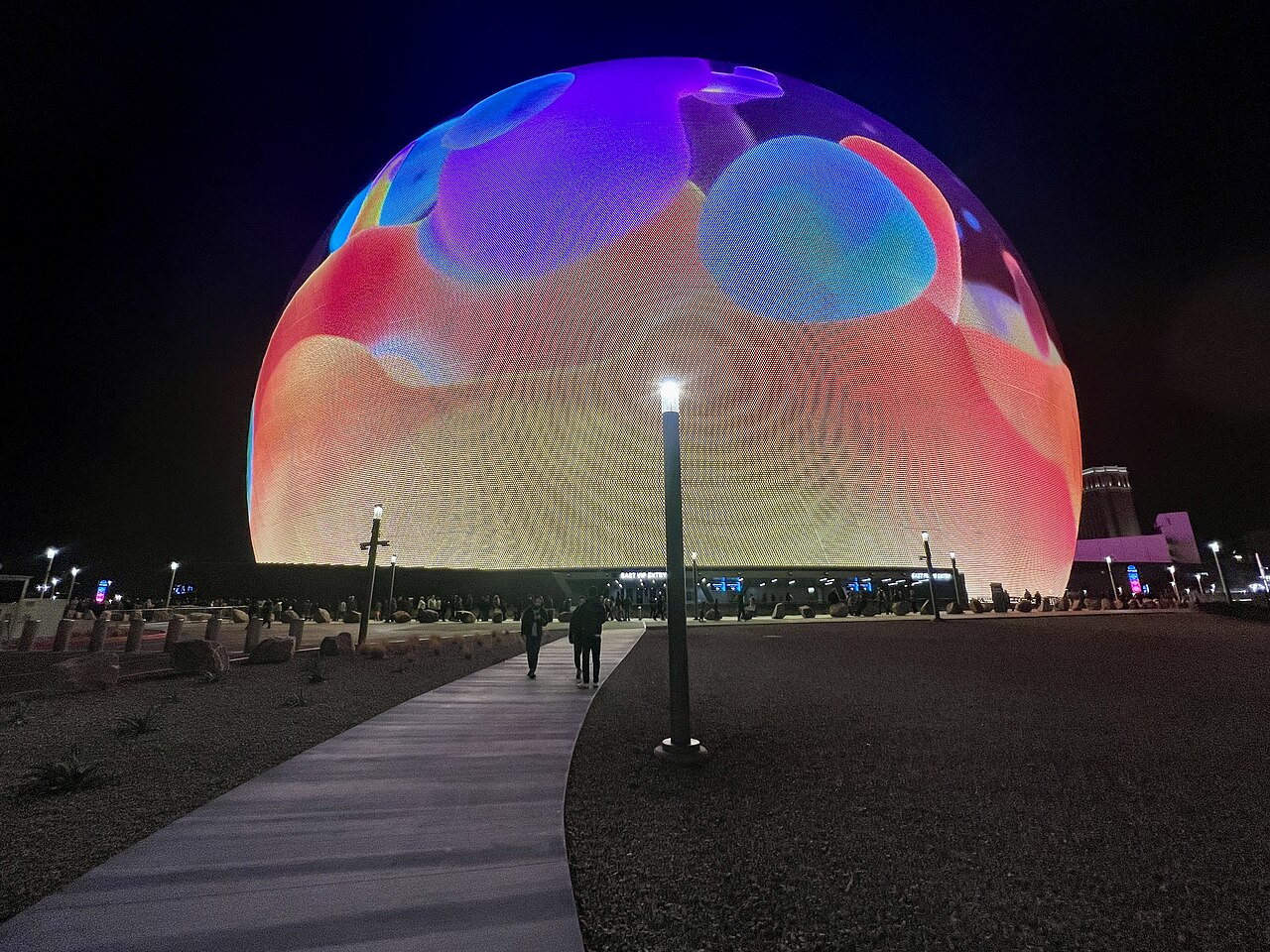
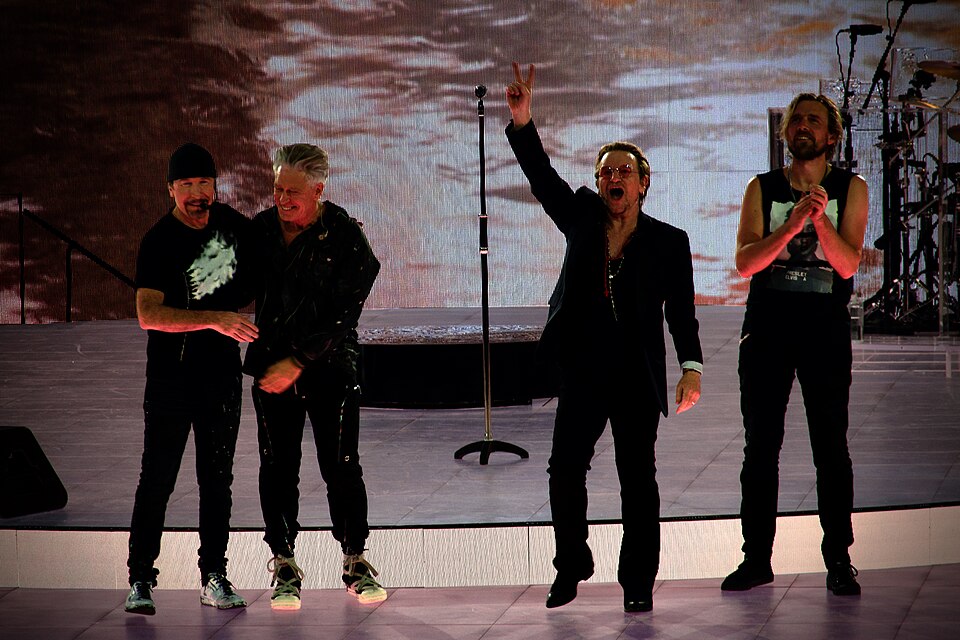
On September 29, 2023, U2 opened the Sphere in Las Vegas with their U2:UV Achtung Baby Live at Sphere residency. What audiences experienced was unlike anything in the history of live entertainment: a 16K LED interior wrapping around and above them, beamforming speakers that could aim sound at individual sections of the 17,600-seat arena, and haptic seats that let them feel the bass through their bodies. The venue cost $2.3 billion. It is the most expensive entertainment venue ever built in Las Vegas — and, depending on who you ask, the most important development in immersive media since the invention of the planetarium.
For the fulldome community, the Sphere is both thrilling and unsettling. It validates everything the field has believed for decades — that immersive, wraparound visual and audio experiences are profoundly more powerful than flat screens. But it does so at a scale and budget that makes even the best-equipped planetariums look like proof-of-concept demos.
This is a deep dive into what the Sphere actually is, technically — and what it means for everyone making work for domes.
📊 The Numbers
🖥️ The Display
The interior LED screen is the single largest and highest-resolution LED display ever built. At 160,000 square feet (roughly 15,000 m²), it wraps around the interior of the venue like the inside of a massive dome — and at 16,000 × 16,000 resolution, it delivers approximately 268 million individually addressable pixels.
The screen was designed and manufactured by SACO Technologies, a Montréal-based LED specialist. It consists of 64,000 LED panels in 780 different geometric shapes, each controlled by its own printed circuit board in an aluminium frame. The edge-to-edge tolerance between panels is just 0.8 millimetres.
Because of the curved surface, the screen uses an adaptive pixel pitch — the spacing between LEDs varies across the surface to prevent distortion near the poles, where a uniform pitch would waste pixels. The screen is also acoustically transparent, meaning sound from the speaker arrays behind it passes through without significant loss.
The Exosphere
The exterior "Exosphere" — visible for miles across the Las Vegas skyline — is a separate 580,000 sq ft LED display, also manufactured by SACO. It comprises 1.23 million puck-shaped LEDs spaced 8 inches (20 cm) apart, each containing 48 individual diodes. This makes it the world's largest outdoor LED display. The Exosphere has displayed everything from emoji characters (Orbi, the Sphere's mascot) to advertisements to digital art installations.
What format does it use?
The Sphere's content format is approximately 1:1 equirectangular, according to Ed Lantz (Dome Fest West forum moderator and Vortex Immersion founder). As Lantz described it in the DFW Cosm and Sphere panel: the screen is "a 16K by 16K screen approximately. I believe they use a one-to-one equirectangular frame format."
This differs from traditional fulldome, which uses the domemaster format — a square frame containing a circular fisheye projection. Cosm, by contrast, uses "more of a two-to-one equirectangular full sphere" where "you don't see the entire sphere, but you can definitely go hyper hemisphere." The format distinction matters: content created for the Sphere is not directly interchangeable with content created for traditional planetariums, and vice versa.
🔊 The Sound
If the display is the Sphere's spectacle, the sound system is its engineering marvel. "Sphere Immersive Sound" is based on Holoplot's X1 Matrix Array — a German-designed speaker system that uses beamforming and wave field synthesis to control sound with a precision no conventional speaker system can match.
The system in numbers
| Total speaker modules | 1,586 permanently installed + 300 mobile |
| Total drivers/amps/channels | 167,000 |
| System weight | 395,120 lbs (179,220 kg) |
| Main proscenium array | 464 Holoplot X1 speakers (272 MD96 + 192 MD80-S) in 14 clusters |
| Environmental arrays | 28 arrays (5× MD96 + 5× MD80-S each) for immersive coverage |
| Effects arrays | 6 arrays (24× MD96 modules each) |
| Surround arrays | 71 behind-audience arrays |
| Coverage range | 110 metres (360 ft) — to reach the furthest seats |
| Amplification | Powersoft 16-channel per module |
What makes it different
Beamforming is the key technology. Each Holoplot X1 module contains a matrix of drivers — the MD96 has 96 drivers, the MD80-S has 80 — and by precisely controlling the phase and timing of each driver, the system can digitally "aim" sound like a spotlight. This means every seat in the 17,600-capacity venue can receive consistent volume without the usual front-to-back falloff that plagues conventional speaker arrays.
Wave field synthesis (WFS) goes further: rather than just directing sound, WFS can create virtual sound sources — acoustic objects that appear to exist at a specific point in space, regardless of where the actual speakers are. This is the same technology that the Satosphere in Montréal uses at a smaller scale, and it's what makes the Sphere's audio genuinely three-dimensional rather than just loud.
The system sits behind the LED screen — 99% of the speakers are hidden — and software algorithms compensate for any transmission loss caused by the screen's obstruction. Additional speaker groups include 12 delay arrays under the main balcony, 10 side-fill arrays, 6 low-fill arrays, and floor-mounted systems that deliver sound through the floorboards.
💺 The Seats
Approximately 10,000 of the venue's seats include haptic technology — physical feedback that lets audiences feel the content. The system delivers tactile vibrations synchronised to the audio and visual content, adding a physical dimension to the experience. The Sphere also features 4D effects including wind and scent machines.
All seats have high-speed internet access, and the venue includes 23 luxury suites across the third and fifth floors.
For fulldome practitioners, the haptic dimension is particularly interesting. Dome audio has always been about physical immersion — subwoofers that you feel in your chest — but dedicated haptic seats take this to a controlled, per-audience-member level. It's a dimension that traditional planetariums haven't explored, though 4D cinema has used similar technology in theme parks for years.
🎬 The Shows
Since opening, the Sphere has hosted an eclectic mix of concerts, residencies, and original film content:
| Show | Type | Details |
|---|---|---|
| U2:UV Achtung Baby | Concert residency | 40 shows, Sep 2023 – Mar 2024. Opening act. |
| Postcard from Earth | Darren Aronofsky film | 45-min immersive documentary. Opened Oct 6, 2023. |
| Dead & Company | Concert residency | 48 shows, May 2024 – May 2025 |
| Eagles | Concert residency | 58 shows, Sep 2024 – Apr 2026 |
| Phish | Concert residency | Two runs: 4 shows (2024), 9 shows (2026) |
| The Wizard of Oz at Sphere | Immersive 4D film | Remastered 1939 classic. Screening from Aug 2025. |
| Anyma | EDM residency | 12 shows, Dec 2024 – Mar 2025 |
| Metallica | Concert residency | 24 shows, Oct 2026 – Mar 2027 |
| UFC 306 | Live sporting event | First live sport at Sphere, Sep 14, 2024 |
In 2024, the Sphere grossed $420.5 million from 1.3 million concert tickets — the highest annual gross of any venue in Billboard Boxscore history.
What makes Sphere content fundamentally different from fulldome is the combination of scale, format, and production budget. Postcard from Earth is a 45-minute film with storage measured in petabytes. The UFC 306 event featured six custom-produced visual vignettes themed on Mexican history, displayed as immersive backdrops for each fight. This is not indie fulldome — it's industrial media production at Hollywood scale, formatted for a dome.
🏛️ Architecture & Engineering
The Sphere was designed by Populous, the architecture firm behind numerous major sports venues worldwide. Structural engineering was handled by Severud Associates and Walter P Moore, with AECOM as general contractor. Acoustics were designed by Arup.
- Feb 2018Project announced as "MSG Sphere"Partnership between MSG Company and Las Vegas Sands
- Sep 2018Groundbreaking ceremonyAttended by Sheldon Adelson and Governor Sandoval
- Feb 2019Construction begins110,000 cubic yards of dirt and caliche excavated
- Mar 2020COVID-19 suspends constructionSupply chain disruption; opening delayed from 2021 to 2023
- Jun 2021Dome topped off3,000 tons of steel in the roof; 170-ton compression ring — heaviest single lift
- May 2022Exosphere topped off30% taller than the dome itself
- Jul 4, 2023Exosphere lit for the first timeWent viral globally during Independence Day
- Sep 29, 2023Grand openingU2:UV Achtung Baby Live at Sphere
The construction required the world's fourth-largest crane — a Demag CC-8800 crawler crane, capable of standing up to 580 feet. It was shipped from Zeebrugge, Belgium, to California, then transported overland to Las Vegas on 120 tractor-trailers. Assembling the crane itself took 18 days and required a separate crane.
Originally budgeted at $1.2 billion, the cost climbed to $2.3 billion due to design enhancements, the COVID-19 pandemic, and the 2021–2023 global supply chain crisis.
🔮 Sphere vs. Fulldome
The fulldome community's reaction to the Sphere has been a mixture of excitement, validation, and existential questioning. The Dome Fest West forum on Cosm and Sphere — featuring Tracy Balls (30 years in themed entertainment), Kirk Johnson (Cosm/Evans & Sutherland veteran), and Ed Lantz (Vortex Immersion) — addressed the central question directly: does the Sphere help or threaten the traditional dome ecosystem?
Johnson's argument: the Sphere is making domes cool. "The general public is seeing and responding to the exterior architecture of the Sphere. It is a dome — obviously immersive environment and people think it's cool and it is cool and it's really uplifting the way people think about immersive domes, fulldomes in our space."
But he also noted the Sphere is "mostly a walled garden for programming — not a lot of things outside of their own concerts and projects." The venue doesn't accept independent submissions the way planetariums and festivals do. And the production budget for a Sphere show is in an entirely different universe from fulldome — Postcard from Earth alone involved years of production and petabytes of storage.
What Sphere proves
Immersive, wraparound visual and audio environments are profoundly compelling. Audiences will pay premium prices and travel specifically for the experience. LED beats projection for brightness, contrast, and true blacks. Spatial audio transforms live entertainment.
What Sphere can't replace
Community-scale shared experience. Accessibility — 17,600 seats but one venue on Earth. Scientific and educational programming. Independent and artist-driven content. The intimacy of a 200-seat planetarium where you can hear a pin drop.
Format differences
Sphere uses ~1:1 equirectangular at 16K. Traditional fulldome uses domemaster (square fisheye). Cosm uses 2:1 equirectangular. These aren't interchangeable — content must be reformatted between venues.
The geometry
Sphere has "IMAX geometry" — similar to an IMAX dome with seating covering approximately two-thirds of the interior. It's not a full hemisphere like a planetarium; the stage occupies the remainder.
Johnson shared a telling anecdote: "Some people don't even know they have an immersive experience in their marketplace until they see a Sphere and then somebody comes along and says, we're like the Sphere. The folks at the Macmillan Planetarium in Vancouver did that — saying, there's a Sphere in Vancouver."
And Ed Lantz noted the IMAX filmmaker reaction to seeing their content on an LED dome at a GSCA conference: "What we saw are a lot of traditional IMAX filmmakers coming into the Cosm LED dome, seeing their content on LED dome and just going, oh my God, this changes everything. Because the LEDs really do the — you don't have the cross-bouncing light issues. You get this really rich blacks and high contrast, HDR."
🌐 Cosm, Sphere, and the Future
If the Sphere is the pinnacle, Cosm is the pathway. Founded on the acquisition of Evans & Sutherland (which has processed pixels for 50+ years) and Spitz (which has built dome structures for 75+ years), Cosm is building a network of LED dome venues for sports and entertainment — 26.6-metre, 12K domes in LA, Dallas, Atlanta, and Detroit — while simultaneously selling LED dome technology to planetariums through their B2B arm.
Kirk Johnson traced the lineage: "The foundation of Cosm experiences is built on planetariums, through the acquisition of Evans and Sutherland. They're using Cosm as a B2B brand to sell the LED domes." Fort Worth, Prague, Arizona Science Center, Reno, and Paraguay all have or are getting Cosm LED installations.
The key difference: Cosm venues are replicable; Sphere is singular. Sphere cost $2.3 billion ("I suspect that number is conservative," Johnson noted) and took five years to build. A second Sphere is planned for Abu Dhabi, "not necessarily with MSG money — I think that's mostly government money." MSG has also announced smaller "mini Spheres" at the 5,000-seat level, though none are in advanced development.
Cosm, by contrast, is building a scalable commercial model — LED dome venues that cost $12–20 million (as opposed to $2.3 billion), can show live sports, concerts, Hollywood films, art installations, and educational content, and can be installed in existing museum buildings.
🛠️ What Makers Should Know
If you're creating content for domes in 2026, here's what the Sphere's existence means practically:
Your audience knows what immersive is now
Before the Sphere, you had to explain what a fulldome is. Now audiences have seen the Exosphere on social media, watched clips of U2 inside it, read about it. The concept of "going inside a dome for a visual experience" no longer needs justification. Use this.
Equirectangular is the emerging format
Sphere uses 1:1 equirectangular. Cosm uses 2:1 equirectangular. Even if your current target is domemaster, rendering in full-sphere equirectangular gives you flexibility for future venues. Robin Sip (Mirage 3D) has been arguing this for years — the domemaster format is evolving.
LED is the future — plan for it
LED domes deliver true blacks, 10× brightness vs. projection, no cross-bounce. Fort Worth, Prague, Arizona are already running Cosm LED. Your content should look good on both projection and LED — which means paying attention to contrast ratios and HDR.
Audio matters more than ever
The Sphere's 167,000-driver Holoplot system proves what spatial audio advocates have been saying: sound is not secondary to visuals. Invest in spatial audio for your dome work — it's the single most under-served area, and the one where a solo creator can genuinely compete.
60fps is the new standard
LED domes demand 60fps minimum. Prague's Martin Fuchs: "30 fps is definitely not enough." If you're rendering for LED dome targets, plan your pipeline for 60fps from the start.
The planetarium is your advantage
Sphere seats 17,600 but there's one on Earth. There are thousands of planetariums worldwide. They accept independent submissions. They serve communities. And as Kirk Johnson said: "the planetariums are already built." Your work can reach audiences in hundreds of venues. The Sphere's work can only be seen in one.
📐 Technical Comparison
| Spec | MSG Sphere | Cosm (LA/Dallas) | Typical Planetarium |
|---|---|---|---|
| Display type | LED (SACO) | LED CX (Cosm) | DLP/Laser projection |
| Resolution | ~16K × 16K | 12K | 4K–8K blended |
| Interior area | 160,000 sq ft | ~2,200 m² (est.) | 300–1,500 m² |
| Capacity | 17,600 seated | ~700 | 100–400 |
| Audio | 1,586 speakers / 167K drivers | Spatial surround | 8–98 speakers |
| Audio tech | Holoplot WFS + beamforming | Integrated spatial | 5.1 to HOA |
| Haptic seats | 10,000 | No | No |
| Content format | ~1:1 equirectangular 16K | 2:1 equirectangular | Domemaster 4K–8K |
| Open submissions | No (walled garden) | Limited | Yes (festivals) |
| Cost | $2.3 billion | $12–20M per venue | $1–10M |
The Bottom Line
The Sphere is not a fulldome venue. It's not a planetarium. It's not competing with your local science museum's dome theater. It's an industrial-scale entertainment venue that happens to prove, at the highest possible budget, that wrapping audiences in light and sound is the most powerful thing media can do.
For the fulldome community, the Sphere is a gift — it validates the format, it excites public imagination, and it makes the word "dome" mean something exciting to a general audience for the first time in decades. But the opportunity is not in trying to replicate the Sphere. It's in doing what the Sphere can't: intimate experiences, independent artistry, scientific storytelling, community-scale shared wonder, and the 1,000+ venues worldwide where your work can actually be seen.
Published March 16, 2026 · Technical specs verified via Wikipedia, SACO Technologies, Holoplot · Community quotes from DFW Forum transcripts · Research: FulldomeFever