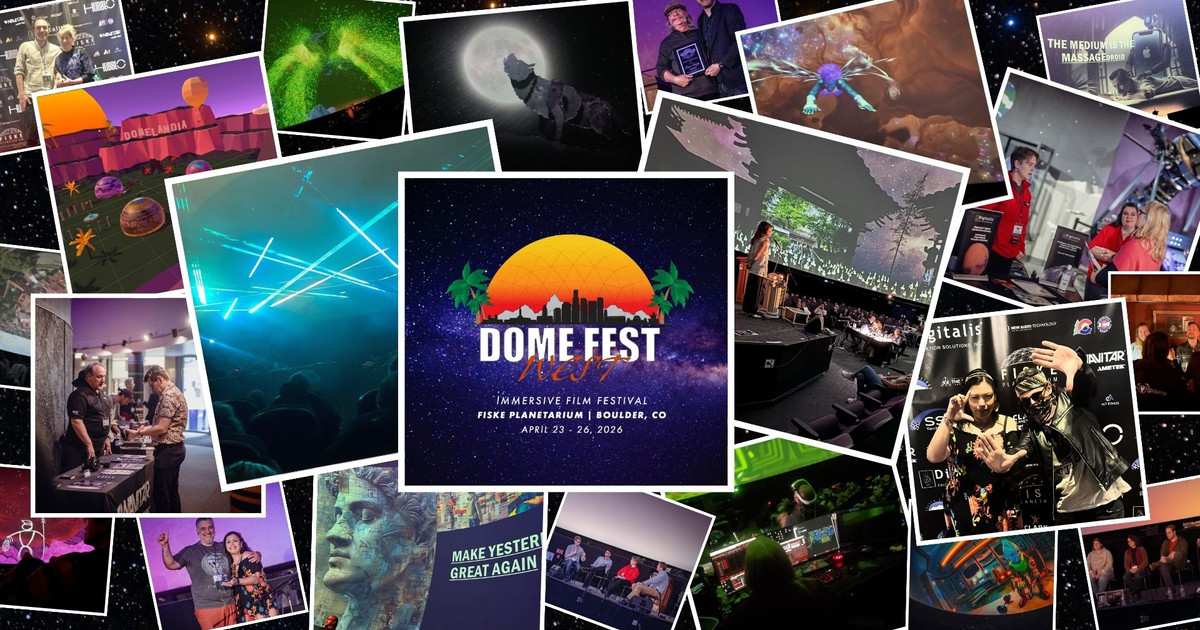
Dome Fest West — the Boulder, Colorado-based nonprofit and film festival — runs a year-round series of online "Full Dome Forum" panels, each tackling a specific aspect of immersive production. These aren't polished keynotes; they're working conversations between practitioners, often revealing the tensions and trade-offs that official presentations gloss over. The 12 forums from the 2024–2025 season cover a remarkable breadth — from how to spatialize a tree's resonant frequencies, to whether the MSG Sphere in Las Vegas will reshape the entire field.
We ran the full set through speech-to-text and did a thematic cross-analysis. What follows is a synthesis of where the fulldome community in the US stands — its consensus points, its unresolved debates, and the technologies shaping its near future.
What the Community Agrees On
Across twelve panels with speakers who span sound design, cinematography, venue architecture, and interactive education, a set of consensus positions emerged with striking consistency.
LED domes are the future — but not yet affordable for everyone
Every panel that touched display technology agreed: LED domes offer dramatically better contrast, brightness, and no cross-bounce. But the cost is 2–2.5× projection systems upfront, and the technology is still maturing. Benjamin Cabout (RSA Cosmos) emphasised that quality varies wildly between LED suppliers.
Audio remains fulldome's biggest blind spot
Independently raised in at least four separate forums. Monica Bowles' IPS survey found 90% of audio creators want more standards. Tom Ammermann: "Audio is 50% of the experience." Bill Peters called most dome audio he'd encountered "somewhere between terrible and just barely good."
The dome master format is evolving
Robin Sip made the case directly: LED domes and hyper-hemispheric venues like Cosm mean "we have to say goodbye to our beloved dome master." Equirectangular is the emerging container format, borrowed from VR, that can serve both traditional domes and new hyper-dome layouts.
Interactivity is the planetarium's secret weapon
Carrie Berglund (LIPS/Digitalis), Brittany Kunder (Intuitive Planetarium), and Michael Schultz (Kinetarium) all demonstrated that live, interactive programs drive higher satisfaction and engagement than pre-recorded shows — and the tools are now mature enough to make this scalable.
Cosm and Sphere are expanding the market, not replacing planetariums
Kirk Johnson (Cosm) explicitly addressed fears that sports/entertainment venues would sideline science and education: "This market continues to be super important to us." The general sentiment: more venues means more audiences, more creators, more content demand.
There is no substitute for the dome itself
Multiple speakers said it independently. Daniel Ferguson: "If it's not on the dome, it doesn't exist." VR headsets help with previsualization, but nothing replaces being in the actual theatre for final grading, sound mixing, and editorial judgement.
On Audio: Three Workflows, Zero Standards
The "Innovative Sound Strategies" and "Advanced Acoustics" forums together paint a detailed — and somewhat alarming — picture of the state of dome audio. Three practitioners each demonstrated a fundamentally different workflow, and none of them could easily deliver to the others' venues.
Alejandra Rios, a sound artist based at Monom in Berlin, works with 4DSOUND — a 48.9-channel system that treats space itself as "an instrument for composition." Her fulldome project Eyespread, which won Best Sonic Experience at Fulldome UK, was built in a chain of Max MSP → Ableton Live → Reaper, using the IEM plugin suite for ambisonic encoding.
Benoit, mixing at the Montréal Planetarium, works in a 17.3 channel configuration — two rings of eight speakers plus a zenith — and hacks Pro Tools' Dolby Atmos panners to fit his custom layout. His practical observation about dome acoustics was memorable: "The dome in itself is a bit more difficult for that because of the shape and also because of the material — perforated aluminium — it's a relatively reflective material. So you have to handle a lot of things bouncing around."
Johannes Krauss, who has scored fulldome shows for over 15 years, uses Tom Ammermann's Spatial Audio Designer inside Nuendo. The key advantage: preset-based export that can target any dome's speaker layout. "I have a lot of presets for different domes. All the domes I've worked for. And this makes it actually pretty easy."
Tiffany Loverd, presenting on the acoustics panel, introduced a genuinely novel concept: Playspace Spatial Audio — capturing the acoustic fingerprint of real-world spaces and rendering it in real time as a complement to object-based audio. "It's not trying to replace Dolby Atmos. We're very complementary." Her technology, called "Real Room," uses transfer functions and quad-volution to give any sound source the sense of existing in a real physical space — relevant for domes wanting to acoustically transport audiences to specific locations.
On Cinematography: The 8K Problem
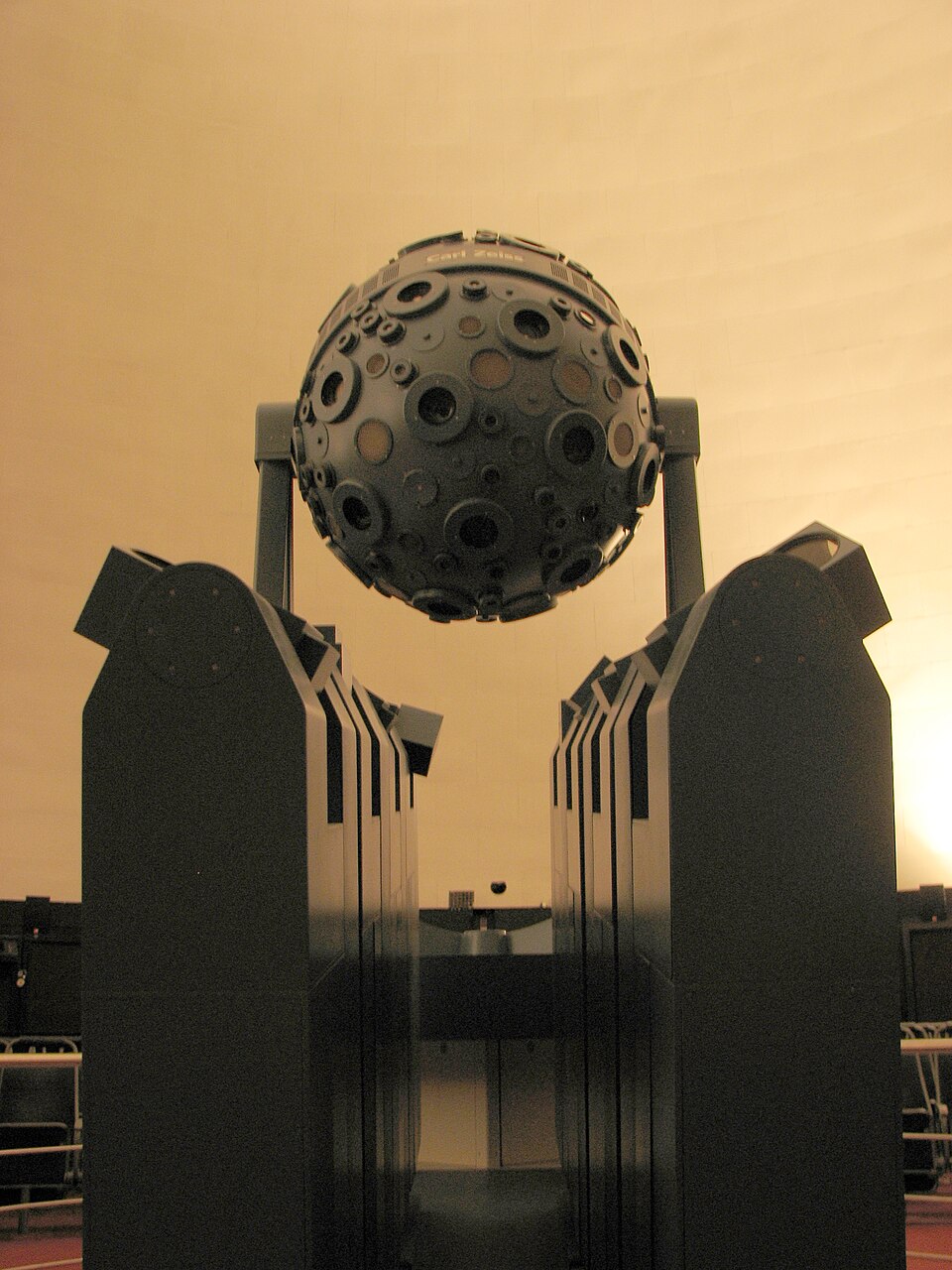
The cinematography forum assembled four of the most experienced immersive camera operators in the world, and their conversation crystallized around one uncomfortable truth: the resolution demands of LED domes are outstripping the capabilities of almost every camera and lens on the market.
Pavel Achtel, creator of the 9x7 camera, framed the problem precisely. The camera was originally designed for the Sphere and can deliver up to 18K of measured, resolved resolution — but even at these specifications, the limiting factors aren't the sensor. "The weakest link is focusing. It's the diffraction. It's the lenses. It's the depth of field." At resolutions above 8K, the aperture sweet spot narrows to a sliver: "f5.6 is already diffraction limiting the images."
Robin Sip (Mirage 3D) demonstrated the evolution from early two-Red-camera rigs in 2014 to his current approach: shooting 40 plates at each location over 30–45 minutes, then stitching them into a single high-resolution panorama. This works for landscapes and slow-moving scenes, but his six-Red-Raptor rig for filming Cirque du Soleil's O show in Las Vegas reveals the extreme measures needed for low-light, high-motion dome content.
Daniel Ferguson (director, Jerusalem, Super Power Dogs, Einstein's Incredible Universe) brought the filmmaker's perspective: story dictates everything. His Heart of New England — a $5.75 million commission from the Museum of Science Boston, shot entirely for dome — used the HAL Entaniya 220° fisheye lens extensively, with 60–70 AI-assisted sky extensions in the DI process. His advice on producing for dome first resonated with the panel: "Ignore the domes at your peril."
The dome is not cinema
Ed Lantz offered the clearest framing of how dome narrative differs from film: "Picture cinema as you looking through a window and seeing something. In the dome, you're in the room. You're part of that experience, whether you want to be in that room or not." Robin Sip agreed but added nuance: "The storytelling might not have to be very different. It's the cinematography that's very different." Conventional editing grammar — close-ups, rapid cuts — causes literal motion sickness in the dome.
The LED Dome Revolution
If there was a single dominant theme across the forums, it was LED. The LED dome forum, the Cosm/Sphere panel, and the venue design discussion all converged on the same conclusion: emissive LED technology is fundamentally reshaping what a "dome" can be.
Kirk Johnson (Cosm, 36 years at Evans & Sutherland) traced the lineage: "We kind of invented computer graphics here in Salt Lake City... We always knew that to get the quality we needed, we had to get to emissive technology." Cosm's CX LED domes are now installed at venues from Fort Worth to Prague, with 26.6-meter 12K domes at their sports and entertainment venues in LA, Dallas, Atlanta, and Detroit.
Benjamin Cabout (RSA Cosmos/Konica Minolta) provided critical context on quality variation: "There are plenty of suppliers that claim they can make LED domes. Very few companies are really serious about what we are doing in domes." He showed side-by-side images of LED domes — one with visible panel outlines and washed blacks, one with "absolutely perfect" uniformity — and warned that planetarium-grade LED requires specific engineering that mass-market LED suppliers don't provide.
Nikki and Jeremiah from the Fort Worth Museum of Science and History provided the most vivid picture of what an LED dome enables in daily operation. Their 23-meter 8K Cosm CX system — the world's first LED dome of that size in a museum — runs educational documentaries during the day, live planetarium shows, concerts, karaoke, trivia, sound baths, movie screenings, and corporate events. "The versatility that we get with the omni theater and with the Cosm technology" allows them to program content that was simply impossible with their previous IMAX projector system.
Hyper-domes and the end of the dome master
LED technology enables new venue geometries that projection never could. Robin Sip showed designs for the Arizona Science Center and the Prague Planetarium — both extending their domes below the horizon into "hyper-hemispheric" layouts. Cosm's venues already project beyond a hemisphere, with image wrapping down to the floor in front of the audience.
This has implications for content format. As Sip put it: the traditional dome master — a circular fisheye image at 4096×4096 or 8192×8192 — can't describe these asymmetric canvases. The industry is converging on equirectangular as a more flexible container, borrowing from VR's established pipeline.
Interactive Planetariums: The Quiet Revolution
The interactive fulldome panel revealed something that the production-focused community doesn't always acknowledge: for planetariums that prioritise live, interactive programs, audience satisfaction metrics are consistently exceptional — and the tooling has matured dramatically.
Carrie Berglund, founder of the LIPS symposium (Live Interactive Planetarium Symposium), drew a firm distinction: "A program can be live without being interactive. A live but non-interactive program is a lecture." Her definition of interactive requires the audience to have "a direct impact on the direction of the program." LIPS has had over 300 unique attendees since 2011, with US regional conferences increasingly incorporating LIPS-style professional development days.
Brittany Kunder from the Intuitive Planetarium at the US Space & Rocket Center (home of Space Camp) shared concrete data: their exclusively live, interactive programming model achieves an average audience score of 3.9 out of 4.0. Presenters use Digistar on iPads, Xbox controllers for live navigation, and modular visual assets they can call up on the fly. Every show is tailored to the specific audience in the dome.
Michael Schultz of Kinetarium took interactivity further: multiplayer video games projected on the dome, where hundreds of audience members simultaneously control individual avatars via their smartphones. Games like Cosmic Carousel — where the audience collectively builds star systems and can merge them into black holes — "attract new audiences that prefer games rather than passive linear content."
David from the Intuitive Planetarium demonstrated "data to dome, dome to phone" — a pipeline where scientific data (like the James Webb Space Telescope's anniversary images) can go from release to immersive dome visualisation within minutes, then be shared as interactive web experiences on audience members' phones via QR code. He showed a Vera Rubin Observatory first-look image — 84,000 × 60,000 pixels — tiled and navigable in real time inside Digistar.
Venue Design: The Details That Make or Break It
The venue design panel — featuring architect Bill Chomick (40+ dome theaters worldwide), planner Bill Peters, and consultant Joyce Town — offered the kind of granular production knowledge that rarely appears in conference talks.
Chomick's key learnings were ruthlessly practical: dark, matte-black surfaces everywhere behind the dome; no visible guardrails (use seat-back heights to meet code instead); air dropped through the perforated dome and pulled out under seats; 5–7 feet of service space behind the dome; matte-black exterior surfaces to prevent light bleed through perforations; and the eternal battle with building inspectors over sprinkler placement.
Peters' contribution was more philosophical but equally important. His insistence that design must start with purpose — "What do they want the audiences to feel? What type of experience will it be?" — led to a concrete example: Lowell Observatory thought they needed a planetarium. After Peters and Ian McLennan conducted a community needs assessment, they built a $63 million Astronomy Discovery Center instead, with a rooftop open-sky observatory and a hemispherical LED screen.
Cosm and Sphere: What It Means for the Community
The Cosm/Sphere panel — moderated by Ed Lantz with Tracy Balls, Kirk Johnson, and others — addressed the question the entire community is asking: do these massive commercial venues help or threaten the traditional dome ecosystem?
The consensus was cautiously optimistic. Tracy Balls, with 30 years in themed entertainment, traced the line from Disneyland's Haunted Mansion through IMAX Omnimax to today's flying theatres: "It's not a matter of 360 — it's a matter of immersion where it's needed." The Sphere and Cosm represent the format going mainstream.
Kirk Johnson (Cosm) argued that the company's vertical integration — Spitz has built dome structures for 75+ years, Evans & Sutherland has processed pixels for 50+ years — creates synergies that benefit both the commercial venues and science/education customers. "There's things that the way we've approached the CX LED system was from a scientific standpoint. There's a certain quality that both the planetarium and the giant screen require that a sports entertainment venue wouldn't require. But because of our approach, it's really benefited our Cosm venues."
Storytelling: Toward a Dome-Native Language
Two speakers from the Jena FullDome Festival's Frameless Forum — Michael Gandham and Sébastien Gauthier — offered perhaps the most forward-looking perspectives on fulldome as a narrative medium.
Gandham, an animator and filmmaker from Newcastle, drew explicitly on Sergei Eisenstein's montage theory. His insight: in dome, you can't cut between angles the way film does, but you can juxtapose images within the same spherical space — Eisenstein's "poetic montage" without the edit. He likened the current state of fulldome to cinema circa 1910: "There are no rules quite yet. Lots of people are experimenting, but there's nothing pulling it all together. It's a bit of a wild west — which is exciting."
Gauthier, a physicist-turned-filmmaker from Montréal who directed EXO: Are We Alone? (Jena Festival Feature Award winner), made a bold prediction: framed images will become "vintage" — like black-and-white or silent film. "I believe that the future is frameless. The frame will disappear and the point of view of the camera will disappear as well." His emphasis on emotion over scientific precision was striking for someone with a physics background: "When I look at the sky at night, what amazes me is not the colour of the stars. It's the fact that it's dark, I'm in a quiet place. I feel the unknown. I feel the adventure."
Software and Tools: What People Actually Use
Across 12 forums, specific tools were named, demonstrated, or recommended by practitioners shipping real work:
The Distribution Question
Tina Ratterman (Big & Digital, Reef Distribution) provided rare insight into the business side. Her biggest news: a US Space Force–commissioned 12-minute fulldome show, Always Above, distributed free to US domes — backed by a six-figure national marketing campaign with geo-targeted local advertising for participating venues. "I just don't know of this ever happening in the full dome industry."
She also announced Reef Distribution's partnership with Sandwich Vision to aggregate fulldome content for the Apple Vision Pro — a "Theater" app that simulates sitting in a dome theatre. Ratterman noted the AVP audience is currently "high-end, not kids — mostly techies," but sees this as another distribution channel for immersive content.
Her advice to producers: involve distributors early. "If you can get the feedback from the buyers working through your distributor before you finalize your film — having that's your distributor service, helping you with that process." And the ongoing tension: flat-rate licensing at $10K/year vs. gate-share models that better reward high-quality content.
What's Still Being Figured Out
- Audio standardisation. The single most-requested improvement across forums. Every venue has a different speaker layout, every creator uses a different tool, and inter-venue portability ranges from "surprisingly good" (Spatial Audio Designer presets) to "we have to redo it" (Benoit mixing at Montréal). Object-based audio may be the path forward, but adoption is inconsistent.
- Live-action at LED-dome resolution. LED domes demand 8K minimum, often 12K–16K. The lens, focus, and diffraction limitations Pavel Achtel described mean that only a handful of camera/lens combinations on Earth can actually deliver resolved pixels at these resolutions. AI upscaling is filling gaps, but it's a workaround.
- Hollywood crossover. The panel was unanimous: traditional Hollywood filmmaking grammar causes motion sickness in domes. The crews aren't trained, the tools aren't ready, and the economics don't work yet. Pavel Achtel: "From a technical point of view, it's not happening anytime soon."
- Business models for fulldome content. Flat licensing fees that don't reward quality. Producers struggling with budgets. Ed Lantz's rental model (Mesmerica/Beautifica) — where the production company rents the theatre and runs its own marketing — is one alternative, but it doesn't scale for smaller operations.
- Format fragmentation. Cosm uses equirectangular. Traditional domes use dome masters. Some venues go hyper-hemispheric. Multiple tilt angles exist. Robin Sip showed a single equirectangular image with lines drawn for different venue formats — a compelling visualisation of why "shoot once, deliver everywhere" is still aspirational.
🎤 Speakers
The 12 DFW forum panels featured practitioners from across the fulldome ecosystem — sound designers, cinematographers, venue architects, software developers, and distributors. Here are the key voices.
Talk Index
All 12 Dome Fest West Forum panels from the 2024–2025 season, with a relevance rating for practitioners making original dome content.
| # | Forum Topic | Key Speakers | For makers |
|---|---|---|---|
| 01 | Innovative Sound Strategies | Monica Bowles, Alejandra Rios, Benoit, Johannes Krauss | Essential |
| 02 | Effective Cinematography | Daniel Ferguson, Pavel Achtel, Robin Sip, Michael Dowd | Essential |
| 03 | New Technology 2025 | Tina Ratterman, Matt Celia, Tom Ammermann | High |
| 04 | Hayden Planetarium Audio | Luke Goodlumis, JJ, Russ Baird | Essential |
| 05 | LED Screens: Cost–Benefit | Benjamin Cabout, Kirk Johnson, Nikki, Jeremiah | High |
| 06 | Cosm and Sphere | Tracy Balls, Kirk Johnson, Ed Lantz | Medium |
| 07 | Interactive Fulldome | Carrie Berglund, Michael Schultz, Brittany Kunder, David | High |
| 08 | Physical Spaces for VR | Ed Lantz, Jeff Brum, Stephen Cartwright | Medium |
| 09 | Dome Venue Design | Bill Peters, Bill Chomick, Joyce Town | High |
| 10 | Advanced Acoustics | Tiffany Loverd, Tom Ammermann | Medium |
| 11 | Gandham on Storytelling | Michael Gandham | High |
| 12 | Gauthier on Techniques | Sébastien Gauthier | High |
What This Means for Makers
If you're making work for the dome in 2026, the DFW forums point to a few actionable conclusions:
- Invest in spatial audio. It's the single most under-served and highest-impact area. The IEM plugins are free. Tom Ammermann's Spatial Audio Designer has a binaural monitoring mode that lets you mix on headphones. Start there.
- Think equirectangular. Even if your current target is a traditional dome master, rendering in full-sphere equirectangular gives you flexibility for Cosm venues, hyper-domes, VR distribution, and future-proofing.
- Get in the dome early and often. VR headsets and NDI preview tools help, but every experienced practitioner in these forums said the same thing: nothing replaces being in the actual space.
- Consider interactivity. The Intuitive Planetarium's 3.9/4.0 audience scores aren't an accident. If you run a venue, live interactive programming drives repeat visits and community trust in ways that pre-recorded shows cannot.
- The LED transition is happening. Budget for it or plan around it — but don't pretend it isn't coming. Fort Worth's experience shows that LED domes don't just improve image quality; they fundamentally change what a venue can do.
Published March 16, 2026 · Analysis based on 12 Dome Fest West Forum panels, 2024–2025 season · domefestwest.com · Transcription: OpenAI Whisper · Synthesis: FulldomeFever