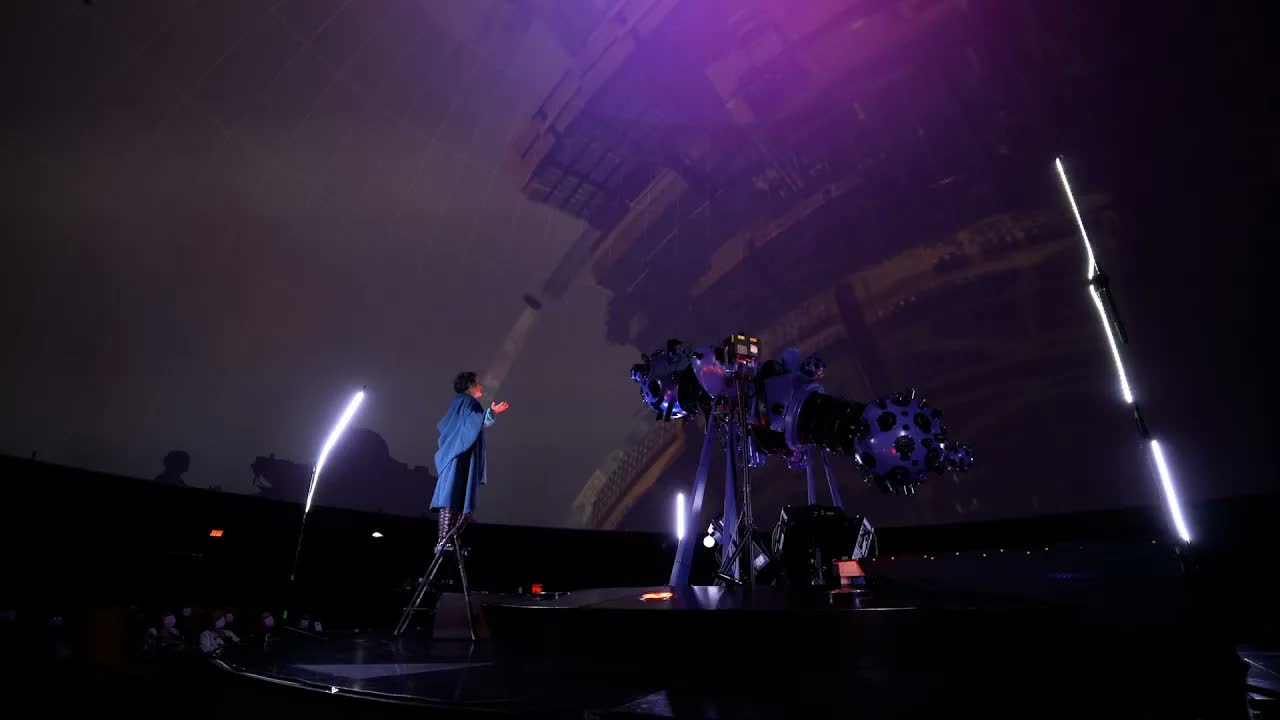
🌎 A Continent Building Its Own Sky
The global fulldome conversation has long centered on Europe and North America — Jena, Montréal, London, Boulder. These are the festivals, the institutions, the names that circulate in the community. It's an understandable bias: the resources were there first, the festivals emerged first, and English-language documentation spreads faster.
But while that conversation has been happening, another one has been quietly building across an entire continent. South American cities have invested seriously in planetarium infrastructure over the past decade — not just in hardware, but in what you do with that hardware. Laser projection systems. Fulldome content production teams. Music events under the dome. International festival programming. Artist residencies. And now, brand-new fulldome festivals launching in 2026.
This isn't a story about a region "catching up." The South American fulldome scene has its own character — grounded in the deep cultural role planetariums play in Latin American public life, energized by a generation of artists who are fluent in immersive media, and increasingly connected to the global conversation. The Fulldome Sudamericano screenings, the new Viva Inmersiva festival in Medellín, the Visiones Art Festival in Lima — these are original contributions, not copies of what's happening elsewhere.
Here's what's happening, country by country.
The Colombian Engine
If you had to point to one country in South America where fulldome is most alive right now — where the venues are most ambitious, the programming most diverse, and the artistic output most internationally visible — it would be Colombia. Two cities, two major planetariums, a new international festival, and multiple artists making it onto the SAT Fest 2026 program. Colombia is not waiting for the rest of the world to notice.
Planetario de Bogotá
Recently renovated to become what its directors describe as the most modern dome in Latin America, the Planetario de Bogotá now runs a full laser projection system and an ambitious programming calendar that goes far beyond science education. The venue has positioned itself as a genuine cultural space — hosting music events, immersive art, and public night programming alongside its educational mission.
The Domo Vivo series has brought live music into the dome — Colombian electronic artists performing under 360° projected visuals. Indie-electronic band Telebit performed there, a moment that generated significant public attention and demonstrated that dome-based music events could draw mainstream Colombian audiences.
The venue's own fulldome productions include Viajeros Insólitos (2022), a fully immersive original show, and Un Viajero Interestelar, a David Bowie tribute experienced entirely inside the dome. These aren't imported shows — they're produced locally, in Spanish, for Colombian audiences.
- Viajeros Insólitos — Original immersive production (2022)
- Un Viajero Interestelar — David Bowie tribute fulldome show
- Domo Vivo — Live music series under the dome
- Planetario Nocturno — Night events and social programming
The Planetario de Bogotá after its modernization — new laser projection and expanded programming. Source: Canal Capital
Telebit performing live at the Planetario de Bogotá as part of the Domo Vivo series — proof that dome-based music events can work for mainstream audiences. Source: Planetario de Bogotá
Viajeros Insólitos — an original immersive fulldome production from the Planetario de Bogotá team (2022). Source: Planetario de Bogotá
Planetario de Medellín — Parque Explora
One of the largest fulldome venues in South America, the Planetario de Medellín sits within the Parque Explora science complex — a major cultural institution that draws huge visitor numbers from across the region. The planetarium runs a diverse fulldome program that includes locally produced Spanish-language shows alongside international content.
The programming balances education with entertainment: kids' shows sit alongside adult programming, and the venue has shown a consistent interest in using the dome format for storytelling that goes beyond conventional science content. Somos Aliens examines the question of what makes us alien to ourselves. Lucía was produced specifically for young audiences. La pregunta de la vida tackles the origins of life with full immersive treatment.
- Somos Aliens — Immersive exploration of identity and the alien within
- Lucía — Children's fulldome show
- La pregunta de la vida — The origins of life, immersively
- Helios: relatos del vecindario solar — The solar neighborhood in full dome
Inside the Planetario de Medellín at Parque Explora — one of the largest fulldome venues on the continent. Source: Telemedellín
A brand-new international fulldome and immersive media festival launching in Medellín this year. Its stated mission: "to celebrate the convergence of culture, art, and technology through immersive media" and to position Medellín — and Latin America as a whole — as global hubs for immersive experiences. This is a serious ambition, backed by a city that has form for turning cultural ambition into reality. Mark the calendar: vivainmersiva.com →
Colombia at SAT Fest 2026
The most visible sign of Colombia's growing presence in the global fulldome community: multiple Colombian artists and studios on the SAT Fest 2026 competition program. These aren't regional participants — they're competing against international work on the world's most prestigious fulldome festival stage.
Gamgie & Diana Medina
Colombian audiovisual artists presenting SCALA, a new fulldome work, at SAT Fest 2026 in Montréal.
Proyecto Aurora
A Colombian immersive art project bringing El Macroscopio to the Satosphère's international competition.
Estudio Dendra
Colombian studio Estudio Dendra with a new fulldome work exploring cartography and personal geography.
Three Colombian entries in a single edition of SAT Fest isn't a coincidence — it reflects a real critical mass of fulldome production capacity that has been building in the country for years.
Brazil: A Scene on Its Own Terms
Brazil operates at a different scale. The country has dozens of planetariums — some of the oldest in South America — spread across major cities that individually dwarf most countries. São Paulo alone has a metropolitan population approaching 22 million people. The fulldome infrastructure is substantial. What's harder to find, at least in English, is deep documentation of the artistic programming that happens inside it.
That's a documentation gap, not an activity gap. The Brazilian fulldome scene is real, active, and increasingly connected to the international conversation — as demonstrated by AVX Lab's appearance at SAT Fest 2026 Pro.
Planetário do Rio de Janeiro
One of the oldest and most beloved cultural institutions in Rio, the Planetário do Rio de Janeiro has been operating since 1968 and remains a major draw for residents and tourists. It has undergone fulldome projection upgrades that allow it to show contemporary immersive content alongside its traditional astronomical programming.
Planetário do Ibirapuera
Located within the iconic Parque Ibirapuera — São Paulo's central cultural park — this is one of the most-visited planetariums in South America by sheer footfall. Programming spans science education to fulldome film, with the venue serving millions of visitors across its long history. Its position within a major urban cultural complex gives it both the audience scale and the institutional support to program ambitiously.
AVX Lab
An immersive media research and production laboratory working at the intersection of audiovisual technology and immersive environments. AVX Lab's researcher Demetrio Portugal is presenting at SAT Fest 2026 Pro — the festival's industry program — alongside speakers from Taiwan's C-Lab and Canada's IM4Lab. This kind of institutional presence at a major international fulldome forum signals that Brazil's professional fulldome community is actively engaged with global discourse, not just producing content in isolation.
Brazil also has a growing portable dome scene — inflatable fulldome structures that can be deployed at festivals, events, and public spaces, bringing immersive experiences to audiences outside major cities. This portable infrastructure is significant: it's how a country with Brazil's geographic scale and economic diversity can build a nationwide dome culture, rather than one concentrated in a handful of major venues.
Blendy Dome VJ & United VJs — Brazil's Global Fulldome Tool
Perhaps Brazil's single most important contribution to the global fulldome scene is a piece of software. Blendy Dome VJ — the fulldome mapping and real-time domemaster slicing application — was created by StudioAvante and United VJs, a Brazilian-founded collective. The tool is used by VJs, planetariums, and dome venues worldwide to map and slice content for multi-projector dome setups.
The team behind it is Brazilian at its core: Pedro Zaz (VJ Zaz) — new-media artist, director, and one of the principal organizers of Fulldome UK — leads the project. VJ Roger S (Roger Mataleo) — creative coder based in São Paulo — is the technical architect, the programmer who built the software. VJ Spetto — director, VJ, content producer with over 20 years of projection mapping and VJing across Brazil and internationally — handles strategy. Together, they built the missing link between VJ software and actual dome projection hardware.
StudioAvante also created Blendy 360 Cam, a Cinema 4D plugin for rendering fulldome content, and FDVJ, further expanding the toolchain. Pedro Zaz also runs VJ University, which has produced Portuguese-language educational content about fulldome history and techniques — building the knowledge base for the next generation of Brazilian dome artists.
Pedro Zaz / United VJs — creator's reel showing fulldome VJing work across international venues. Source: COLORs CREATION
Empathy — a 360° fulldome AV show by VJ Spetto (StudioAvante / United VJs). Source: VJ Spetto
Argentina: The Dome as Cultural Stage
The Planetario Galileo Galilei in Buenos Aires is one of the most recognizable buildings on the continent — a flying-saucer structure in the middle of the city's park system that has become an architectural landmark as much as a scientific institution. For decades it was a traditional planetarium. In recent years, it has evolved into something more complex: a venue that holds its public education mission while also hosting fulldome concerts, immersive art events, and spectacular productions that draw very different audiences.
Planetario Galileo Galilei
Inaugurated in 1966, the Galileo Galilei planetarium is an architectural icon — its distinctive flying-saucer form has made it one of the most photographed buildings in Buenos Aires. The venue underwent fulldome projection upgrades that allowed it to screen contemporary digital content, and more recently it has opened its dome to cultural events that go well beyond standard planetarium programming.
The BIENALSUR international art biennial has used the planetarium as a venue for fulldome concerts — immersive audiovisual experiences where music and 360° visuals are combined inside the dome. These events connect the Buenos Aires art world to the global immersive scene in a way that standard science programming never could.
Fulldome Argentina — an Argentine production collective — produces original fulldome shows and portable dome content, building a local content ecosystem rather than relying entirely on imported international programming.
BIENALSUR fulldome concert at the Planetario Galileo Galilei, Buenos Aires — immersive audiovisual art inside one of Latin America's most iconic domes. Source: BIENALSUR
Fulldome Argentina's portable dome in action — bringing fulldome experiences beyond fixed venues. Source: Fulldome Argentina
Planetario Espectáculos production at the Galileo Galilei — the dome as a stage for cultural programming. Source: Canal de la Ciudad
Chile: A University Dome with Real Ambition
Chile's fulldome story is concentrated in Santiago, at a venue with a long history and a genuinely eclectic programming approach. The Planetario Chile at the Universidad de Santiago de Chile has been running for over four decades — and in that time it has developed a relationship with the city's cultural life that goes well beyond education.
Planetario Chile — USACH
The Planetario de la Universidad de Santiago de Chile (USACH) has been operating since the early 1980s and remains one of the most active dome venues in the country. It runs both traditional fulldome science programming and a robust calendar of cultural events — music shows, art exhibitions, and immersive experiences that draw audiences well beyond the usual planetarium demographic.
Music in the dome is a specialty: the venue has hosted tribute shows to Coldplay and The Beatles presented as full immersive experiences, as well as Van Gogh-under-the-dome visual exhibitions. These aren't gimmicks — they're a considered strategy to use the dome format to reach audiences who might never come for an astronomy show.
The KUZE fulldome exhibition represents the venue's engagement with contemporary fulldome art — international immersive work brought to Santiago for local audiences. This kind of curatorial programming, connecting Chilean audiences to the global fulldome scene, is exactly what turns a venue from an attraction into a cultural institution.
40 years of the Planetario USACH — four decades of dome culture in Santiago de Chile. Source: Planetario Chile
The KUZE fulldome exhibition at Planetario Chile — international immersive art brought to Santiago audiences. Source: Planetario Chile
Peru: Lima as an Immersive Art Hub
Peru's contribution to the South American fulldome scene has a distinctive character: it's centered not just on a single venue, but on a festival that has actively positioned Lima as an international destination for immersive art. The Visiones Art Festival, running at the national planetarium, has brought together artists from across Latin America and Europe for events that feel genuinely international in scope.
Planetario Digital de Lima — Planetario Nacional Mutsumi Ishitsuka
Run by the Instituto Geofísico del Perú, the national planetarium in Lima was recently upgraded with a modern full-dome projection system — a substantial institutional investment that reflects a genuine commitment to keeping the venue at the forefront of what planetariums can do. The venue is named after Mutsumi Ishitsuka, a Peruvian-Japanese scientist who contributed to the IGP's work.
The planetarium has become the home of the Visiones Art Festival — a programming choice that signals a willingness to use the national institution's space for experimental international art, not just public education.
Visiones Art Festival
Running at the Planetario Digital de Lima, the Visiones Art Festival has established itself as the primary venue for international fulldome art in Peru — and one of the most interesting curatorial voices in South American immersive culture. Its programming draws on the global fulldome circuit while specifically amplifying South American voices.
Recent editions have shown work by MONOCOLOR (Latent Space), Medusa Lab from Mexico, and Jérémie Bellot's A Metabolist Utopia. Crucially, the festival has also hosted Fulldome Sudamericano screenings — dedicated programs of South American fulldome productions, treating the continent's own creative output as worthy of festival attention.
Inauguration of the upgraded Planetario Digital de Lima — the national institution that hosts the Visiones Art Festival. Source: Instituto Geofísico del Perú
Fulldome Sudamericano screenings at Lima's Visiones festival — South American fulldome work presented to South American audiences. Source: Visiones Art Festival
Aftermovie from the Visiones Art Festival — Jérémie Bellot's A Metabolist Utopia at the Planetario Digital de Lima. Source: Visiones Art Festival
Uruguay: Montevideo Has Its Own Festival
Uruguay punches above its weight. A country of 3.5 million people, squeezed between Argentina and Brazil, has developed a fulldome scene centered on its capital — with a planetarium that runs genuinely innovative programming and, crucially, its own dedicated fulldome festival.
Planetario de Montevideo
The Planetario de Montevideo has developed a programming identity that leans into the social and interactive possibilities of the dome format. Interactive music events — where live performance and dome visuals create a shared experience — have become part of the venue's regular calendar. This approach treats the dome not as a cinema (passive) but as a concert hall (communal and live) — a distinction that matters for how audiences relate to the experience.
Interactive music event at the Planetario de Montevideo — live performance inside the dome. Source: Planetario de Montevideo
Uruguay hosts its own dedicated international fulldome festival in Montevideo. For dates, lineup, and submission info, see our full festival page: Montevideo Fulldome →
The New Festival Landscape
What's changed most significantly in South American fulldome culture in the past few years isn't the venues — many of those have been there for decades. It's the emergence of dedicated festivals that connect venues, artists, and audiences across the continent and internationally. The festival infrastructure is what transforms a collection of individual venues into a scene.
Brand new for 2026. An international immersive media festival aiming to position Medellín and Latin America as global hubs for immersive experiences. The most ambitious new festival launch in the region.
vivainmersiva.com →Running at the Planetario Digital de Lima, Visiones curates international fulldome art alongside specifically South American programming — including the Fulldome Sudamericano screenings.
visionesartfestival.com →Uruguay's dedicated international fulldome festival — proof that a small country with a real scene can create its own gathering point for the community.
Festival page →SAT Fest 2026 includes multiple South American entries in competition (Colombia), a Brazilian researcher at the Pro program, and growing visibility for the region's work on the world stage.
SAT Fest page →Fulldome Sudamericano
Worth calling out separately: the Fulldome Sudamericano is both a screener and a statement. Curated programs of South American fulldome productions — screened at festivals including Visiones in Lima — represent the region's assertion that its own creative output is worth programming on its own terms. Not as local content quotas or regional representation in a predominantly northern program, but as a dedicated curatorial act that says: this work exists, it's good, and it deserves its own spotlight.
As the output of Colombian, Argentine, Peruvian, and Brazilian studios grows, the Fulldome Sudamericano is the mechanism that turns that output into a visible, shareable, international statement about what South American fulldome looks like.
🌐 What Comes Next
The trajectory is clear. South American fulldome isn't approaching some future tipping point — it's already past it. The infrastructure is there. The production capacity is building. The festivals are launching. And the artists are showing up in Montréal.
What tends to happen when a regional scene reaches this kind of critical mass is that it stops being defined by its relationship to the "established" centers and starts producing its own reference points. Colombia is already doing this: the Domo Vivo series at the Bogotá planetarium, the Viajeros Insólitos production, the Viva Inmersiva festival — these are things that other parts of the world are going to want to import, not the other way around.
The deeper story is about what happens when you give planetarium infrastructure a cultural mandate. South American planetariums have, by and large, maintained strong public missions — they're civic institutions in a way that commercial venues often aren't. When those institutions decide to program immersive art, music events, and international festivals alongside their educational work, they bring a kind of legitimacy and public reach that's hard to replicate in a purely commercial context.
The connection between planetarium infrastructure and artistic use — the pivot from "science education with stars" to "immersive culture with everything" — is happening everywhere in the world. But it's happening particularly fast and particularly interestingly in South America, because the venues were often built with the expectation that they would serve entire communities, not just astronomy enthusiasts. That sense of civic purpose gives the programming an ambition that purely commercial venues struggle to match.